
AC Repair in Bossier City for Any Brand, Day or Night
When the house hits 84 and the vents are blowing room-temperature air, the first job on any AC repair in Bossier City is finding out why. That's what our $99 service call covers. An AC tech comes to your home, figures out what failed, and tells you what the repair costs. You decide from there.
Our phone is answered around the clock, most repairs are finished the same day, and our central AC repair covers every make, from a five-year-old Trane to a 20-year-old Goodman.
- 24/7 emergency service
- Locally owned since 2010
- Licensed and insured
- 100% satisfaction guarantee
- Trane and Mitsubishi dealer
- Louisiana commercial contractor license CL.61528
AC Running but Not Cooling?
When an AC runs but blows warm air, or just doesn't cool the house, the usual causes are restricted airflow, a tripped breaker, a failed part at the outdoor unit, or a refrigerant leak. A dirty filter, a thermostat setting or a tripped breaker is the cause often enough that they're worth two minutes before you call:
- Thermostat. Set it to Cool, fan on Auto, a few degrees below the room temperature.
- Filter. A clogged filter chokes the airflow until the indoor coil freezes.
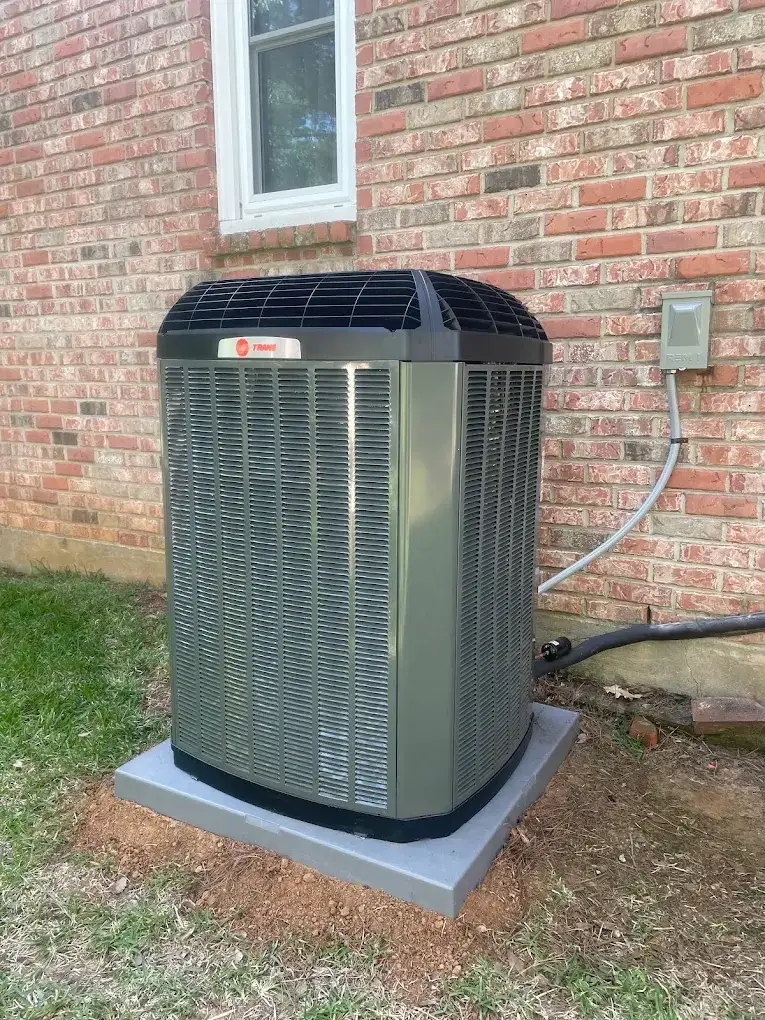
- Outdoor unit. Is the fan on top spinning? Is the unit humming without starting? Either one points to an AC condenser repair, usually a capacitor, a contactor or the fan motor.
- Ice. Frost on the copper lines or ice on the indoor coil means turn the AC off at the thermostat, set the fan to On, and let the ice melt completely, which can take several hours. Running it frozen can damage the compressor.
- Breakers. The indoor and outdoor units usually have separate ones.
If the air is still warm, the cause is usually one of the parts below, or low refrigerant from a leak.
If the filter is clean, the thermostat is on Cool and the vents still blow warm, turn the system off at the thermostat and call (318) 459-7575. Don't open the outdoor unit or touch the wiring. A weak part or a leak is a job for a tech, and running the system that way can damage the compressor.
Why Your AC Is Freezing Up
Ice on an air conditioner means the indoor coil has gotten too cold, most often because airflow is blocked or the system is low on refrigerant from a leak. Turn the cooling off and let it thaw before you do anything else.
Frost on the copper line at the outdoor unit, ice on the indoor coil, or weak, warm air from the vents are the usual signs. Here is what to do:
- Set the thermostat to Off. To thaw faster, set the fan to On so air moves across the coil. Let the ice melt completely, which can take several hours.
- Check the filter. A clogged one is the most common reason a coil freezes. Replace it if it's dirty.
- Make sure the vents are open and nothing is blocking the return grille.
- Once the ice is gone, turn the AC back on. If ice comes back, the cause isn't the filter.
Don't chip or scrape the ice, and don't run the AC while it's frozen. Running it frozen can damage the compressor.
| Cause | What it looks like |
|---|---|
| Dirty filter or blocked vents | Weak airflow, ice returns after thawing |
| Dirty indoor coil or weak blower | Weak airflow even with a clean filter |
| Low refrigerant from a leak | Ice again within days, with or without weak airflow |
If it freezes again after you've changed the filter, a tech should check the coil, the blower, the drain and the refrigerant charge.
How an AC Repair Visit Works
- You call. Day or night, tell us what the system is doing and we'll get your AC service call on the schedule.
- An AC repair technician shows up. They start at the thermostat, then check the outdoor unit, the indoor coil and the drain.
- The diagnosis is $99.
- You get the price. The technician explains what failed, shows you the part when they can, and quotes the repair.
- You say yes or no. Approve it and most common repairs get done on the spot.
- We test it. Before leaving, the tech runs the system and makes sure cold air is coming out of the vents.
Why Homeowners Choose Us for AC Repair
- Fully stocked trucks. We keep our trucks fully stocked, and when the part is on the truck, we can finish the repair in the same visit.
- Training that doesn't stop. Our AC repair technicians keep training on current equipment and methods.
- Work we make right. 100% satisfaction guarantee. If something isn't right with work we did, we'll come back and make it right.
AC Parts That Fail Most Often
Most air conditioning repair comes down to a handful of parts. Here's how each one acts when it goes bad.
Capacitors
The capacitor gives the compressor and fan motor a jolt to get them started. When it weakens, the outdoor unit hums or clicks and never really starts, while the fan inside keeps blowing warm air. Heat is hard on capacitors, so July and August bring a lot of these calls. AC capacitor replacement is one of the quicker and cheaper fixes.
Contactors
A contactor is the switch that turns the outdoor unit on when the thermostat calls for cooling. If its contacts get pitted or stuck, the unit won't start, or it won't shut off. Fire ants are drawn to them, and a nest can jam the switch.
Condenser Fan Motors
Look at the big fan on top of the outdoor unit. If the unit is running and that fan isn't spinning, the compressor can overheat fast. Turn the system off at the thermostat and call us for AC fan repair.
AC Compressor Repair
The compressor is the heart of the system and the most expensive part to replace. AC compressor repair sometimes comes down to a hard-start kit that gets a struggling compressor going again, or a bad contactor or capacitor that's making it look dead. When one has truly died on an older unit, we'll go over whether an AC compressor replacement or a whole new system makes more sense for you.
Drain Lines and Float Switches
In our humidity, a central AC pulls gallons of water out of the air every day, and all of it leaves through a small PVC drain line. Algae and sludge clog that line. Then the pan fills, and either water comes through the ceiling or a float switch shuts the AC off to stop it. We clear the line and can add a cleanout so it's easier to keep flowing.
Thermostats
A dead thermostat looks exactly like a dead air conditioner. We check it first. Every so often the whole repair is fresh batteries or a wire that worked loose.
A blank screen with fresh batteries usually means the thermostat isn't getting power from the system, often because the drain safety switch shut it off or a small fuse blew on the indoor unit's control board. To reset an AC after a power blip, turn it off at the thermostat, flip its breaker off for a minute, turn both back on and give it about 3 minutes before it starts cooling.
AC Coil Leaks and Refrigerant
Refrigerant (most people still call it Freon) doesn't get used up. If your system is low, it's leaking, usually at the indoor evaporator coil or the outdoor condenser coil.
Watch for ice on the copper line at the outdoor unit, an AC that runs all afternoon and never catches up, or a hiss near the indoor unit. Any of those can mean a leak.
The refrigerant lines that run between your indoor and outdoor units, called the line set, can leak too, not just the coil. Our EPA-certified technicians find the leak and repair it, or replace the line if the line is the problem. This isn't a do-it-yourself job, because refrigerant work takes EPA certification.
Here's how we handle it:
- Find the leak first. We use current leak-detection methods: an electronic leak detector, a bubble test on the joints, or a nitrogen pressure test, depending on the system.
- Fix what can be fixed. A leak at a reachable joint or valve can often be repaired.
- Replace the coil when the leak is in the coil itself, which happens a lot once a system passes the 10-year mark.
- Talk about replacement when the system is old enough that a new coil doesn't make sense.
Systems built before 2010 often run on R-22, and R-22 hasn't been made in the U.S. since 2020. That makes recharging one of those systems expensive. If yours takes R-22 and it's leaking, it's usually time to look at a new AC.
Adding refrigerant without fixing the leak only buys a few weeks or months. We won't keep refilling a leaking system every summer without telling you that's what's happening.
Emergency AC Repair
We provide 24 hour AC repair with no after-hours voicemail, and our emergency HVAC service covers heating too. When you call (318) 459-7575 at night, a member of our team answers and gives you a time for the visit on that call.
If the AC quits during a heat wave and someone at home is elderly, a baby, or sick, tell us when you call. While you wait, our 24 hour emergency AC repair page lists what to check.
What Affects the AC Repair Price
We can't quote an air conditioning repair over the phone, because the same symptom can come from an inexpensive part or a failing compressor. What we can tell you is how the price is set. The $99 service call covers the diagnosis. After that, the tech gives you the price for the repair, and you approve it before any work starts, so there's no surprise on the bill.
What moves the AC repair price:
- The part. A capacitor or contactor is a small repair. A blower motor costs more, and a compressor or a coil is the big one. AC compressor replacement cost depends mostly on the size of the unit, the refrigerant it uses and whether the compressor is still under warranty.
- Refrigerant. A leak has to be found and fixed first, and older R-22 refrigerant costs far more than today's refrigerants.
- Warranty. If the part is still under the manufacturer's warranty, you may pay only for the labor.
- Access. An attic unit in a tight space takes longer than one in a closet.
On an older system facing a costly repair, like a compressor replacement, we'll give you the cost of a new system too, so you can compare. Repairs can be financed.
Repair or Replace Your AC?
A 6-year-old system with a bad capacitor is worth fixing. A 17-year-old R-22 unit with a leaking coil is a different conversation, and when AC replacement is the smarter move, we use a $5,000 rule to help people decide. Age matters too, and our installation guide explains how long an AC lasts here.
Where We Do AC Repair Beyond Bossier City
Most of our air conditioner repair service calls are right in Bossier City, where our location is, and we also fix AC units all over Shreveport, Haughton, Benton and the towns between. Across the Red River that means AC repair in Shreveport, and out east it means AC repair in Haughton.
Catching these problems early is the point of our $125 AC tune-up each spring.
AC Repair Questions
How much does it cost to fix an AC unit?
AC repair in Bossier City starts with a $99 AC service call that diagnoses the problem. The repair price depends on the part: a capacitor or contactor typically costs far less than a coil or a compressor. You approve the price before any work starts.
How much does it cost to replace an AC compressor or capacitor?
Of all AC repairs, a capacitor is typically one of the lower-cost ones, while the compressor is typically one of the most expensive parts of an air conditioner. The price depends on your system's model, age and the part that failed. Our $99 service call diagnoses the problem so you know what failed, and the repair estimate is free after that diagnosis. If an AC compressor repair would be a big share of what a new system costs, a new AC system may make more sense, and that estimate is free too.
How do I stop my air conditioner from leaking water?
Shut the AC off at the thermostat first. Then look at the drain pan under the indoor unit and the end of the drain line outside. A wet/dry vac on the outside end can pull a clog loose. If the water comes back, or the pan has rusted through, call us.
What is the 3-minute rule for AC?
After an AC shuts off, give it about 3 minutes before turning it back on. The pressures inside need time to even out, and restarting too soon strains the compressor.
Why does my AC keep turning on and off every few minutes?
That's called short cycling, and it usually comes down to restricted airflow, a system that's too big for the house, or a part that's failing. Replace a dirty filter, make sure the thermostat is on Cool with the fan on Auto and has fresh batteries, and, with the system turned off at the thermostat, clear leaves and debris from around the outdoor unit. If it keeps cycling, turn it off and call us, because short cycling wears out the compressor early. A frozen coil or low refrigerant can also cause it.
Short cycling is different from the 3-minute wait after a shutoff, which is the normal restart delay.
Can I fix my air conditioner myself?
You can do some of it yourself. Change the filter, reset a tripped breaker once, put new batteries in the thermostat, and clear leaves and grass away from the outdoor unit. Leave the rest to a tech. Capacitors hold a charge even with the power off, and refrigerant work legally requires EPA certification, which our technicians hold.
Can I add refrigerant to my AC myself?
No. Under federal law (EPA Section 608), only EPA-certified technicians can buy and add refrigerant for a home air conditioner, and our techs are EPA-certified. Low refrigerant means a leak, and adding more without fixing the leak only delays the problem. Don't open the outdoor unit. Turn the AC off at the thermostat and call us.
Is it safe to keep running my AC if the outdoor unit is buzzing or grinding?
No. Turn the AC off at the thermostat and call us. A steady buzz with the fan not spinning often means a capacitor or motor is struggling to start, and a grinding or banging sound can mean a failing fan motor or compressor. Running it can overheat the compressor and turn a small repair into a big one. Keep your hands and tools out of the unit.
Before you call, note whether the fan on top is spinning, whether the unit hums or clicks, and how long it has been doing it. That helps us diagnose the problem faster.
What should I do if my air conditioner freezes up?
Turn the thermostat to Off and set the fan to On so the ice can melt completely. Replace a dirty filter and make sure the vents are open. If the AC freezes again after that, call us. Low refrigerant from a leak or a failing blower can be the cause.
Call for AC Repair in Bossier City
Tell us what the AC is doing, and we'll find the soonest time a technician can be there.